Ask most people what happens to intelligence after about twenty-five and they will say it declines. That is half right, and the half it gets wrong is the half that matters for most of your working life.
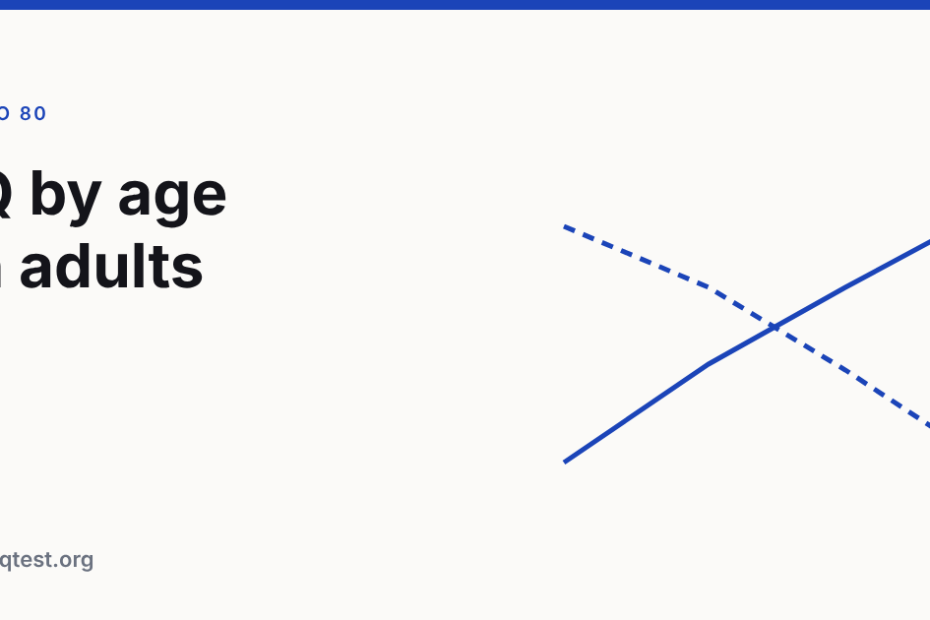
Adult intelligence is not one thing on one trajectory. It is at least two things moving in opposite directions, and the crossover is why a person at fifty-five can feel slower than they were at twenty-five and simultaneously be better at their job than they have ever been.
The two curves
Fluid reasoning is the ability to solve a problem you have never seen, with no relevant prior knowledge. Pattern recognition, working memory, holding several constraints in mind at once. It is what a matrix test measures.
Crystallised knowledge is everything you have accumulated and can use. Vocabulary, facts, the professional judgement that comes from having seen a thousand versions of a situation.
Fluid reasoning peaks early and declines steadily. Salthouse’s analysis put the beginning of measurable age-related decline in several cognitive abilities considerably earlier than most people assume, in the twenties rather than at sixty (Salthouse, 2009). That finding was widely reported at the time, usually with an alarming headline attached.
Crystallised knowledge climbs for decades. Vocabulary typically peaks somewhere in the sixties. Someone of sixty knows far more words, and uses them far more precisely, than they did at twenty-five.
| Kind of task | When it peaks | What it looks like in life |
|---|---|---|
| Processing speed | Early twenties | How fast you take in something unfamiliar |
| Working memory | Late twenties | Holding several things in mind at once |
| Abstract reasoning | Late twenties to thirties | Spotting the rule in something new |
| Vocabulary | Sixties | Range and precision of language |
| General knowledge | Sixties or later | Accumulated facts about the world |
| Judgement in a familiar field | Fifties to sixties | Knowing which problems matter |
Why the decline is less alarming than it sounds
Three reasons, and they are not consolation prizes.
The first is that the early decline is measured on tasks deliberately designed to be unfamiliar. That is the point of a fluid reasoning test. Almost nothing in adult life is like that. Most difficult problems you face at forty-five are in a domain you know something about, and knowing something about it is precisely what has been improving.
The second is that the averages conceal enormous individual variation. The curve is a population average, and plenty of individuals hold steady for far longer than it suggests.
The third is that the measured decline in your twenties and thirties is small in absolute terms, and it is being measured with instruments sensitive enough to detect it. You will not notice it. People reliably start noticing somewhere in their fifties or sixties, which is when the fluid decline has accumulated enough to show up in daily life.
The scoring quirk nobody expects
Here is something that surprises people who retake a test decades apart: your IQ score can stay almost identical while your raw performance drops substantially.
IQ is scored against your own age group. A seventy year old is compared against other seventy year olds, not against twenty-five year olds. If your fluid reasoning declines at roughly the same rate as everyone else’s, your position in your age group does not move, and your IQ score does not move either.
So a stable IQ across adulthood does not mean stable ability. It means stable ranking. Understanding how that norming works explains a lot of otherwise confusing results.
There is a second scoring wrinkle. Population scores drifted upward for most of the twentieth century and then, in several countries, downward (Flynn, 1987). A score you were given in 1985 was measured against 1985, and is not comparable with one taken now. That drift catches out anyone comparing an old score with a new one.
The adult test in ten languages
An age-adjusted reading takes about fifteen minutes. The items are nonverbal, so only the instructions and the results differ between these versions:
- free IQ test for adults (English)
- kostenloser IQ-Test online (German)
- test de IQ gratis online (Spanish)
- test de QI gratuit en ligne (French)
- test QI gratis online (Italian)
- gratis IQ-test online (Dutch)
- test IQ za darmo online (Polish)
- gratis IQ-test online (Swedish)
- 無料IQテスト (Japanese)
- 免费IQ测试 (Chinese)
What actually helps
Brain training does not transfer to general ability, and the evidence on that is now fairly settled.
What is associated with holding cognitive function longer is duller and better evidenced: cardiovascular health, hearing (untreated hearing loss is a substantial and correctable risk), sleep, and continued engagement with genuinely difficult material rather than with puzzles designed to be measured.
The hearing point deserves emphasis because it is so often missed. An older adult who cannot hear well is deprived of a great deal of cognitive input, and the effect on testing and on daily function is real and fixable.
In my experience
I retook a matrix test at forty-one, a decade or so after the last time, half expecting to be depressed by the result.
My score was within a couple of points of what it had been. What had changed was how it felt. At thirty I had worked through those puzzles quickly and without much effort. At forty-one I was slower, I checked more, and on two items I had to stop and consciously work out what rule was operating instead of simply seeing it.
Same number, different experience, and the number was the thing that was misleading me. It had held because everyone my age had slowed by roughly the same amount. What I was noticing was real and the score was never designed to show it.
I found that oddly reassuring rather than otherwise. The compensation is also real: I am considerably better now at knowing which problems are worth the effort, which is not on any test I have ever taken.
Taking a reading
An adult IQ test gives you a position within your own age group. That is a useful thing to know and it is not a measure of your absolute cognitive capacity, which the test was never trying to report.
If you want one, the free IQ test for adults is nonverbal, takes about fifteen minutes, and reports a percentile alongside the score. If you are testing a child rather than yourself, use the children’s version, which is normed by age band.
Read the result as a range, not a point. The percentile is the part that carries the meaning, and if the number comes in lower than you hoped, the ordinary explanations are worth working through before you conclude anything. For how much any of this predicts about outcomes, ability is only one of the two things that matter.
References
- Salthouse, T. A. (2009). When does age-related cognitive decline begin?. Neurobiology of Aging, 30(4), 507-514. doi:10.1016/j.neurobiolaging.2008.09.023
- Flynn, J. R. (1987). Massive IQ gains in 14 nations: What IQ tests really measure. Psychological Bulletin, 101(2), 171-191. doi:10.1037/0033-2909.101.2.171